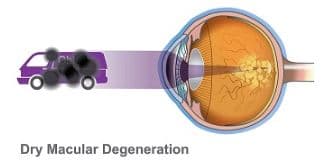
1) Dry or Atrophic AMD
This affects 80% of patients and is characterised by a slow and progressive onset. The formation and accumulation of lipid deposits, or drusen, in the area cause the macula to atrophy, leading to a gradual loss of vision in the central part of the patient’s visual field.
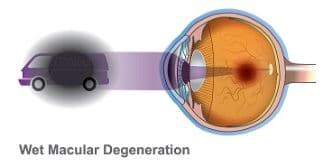
2) Wet or Exudative AMD
This is characterised by the growth of new blood vessels with very thin walls, which end up leaking fluid and blood into the macula. These blood vessels cause rapid vision loss.
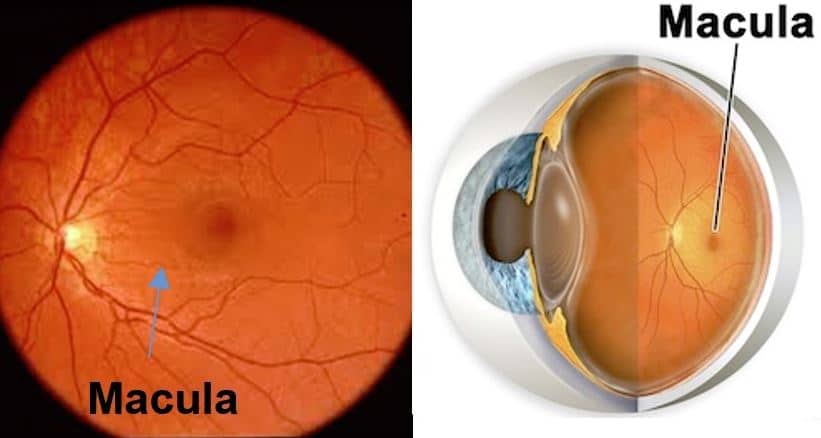
The macula is located at the centre of the retina. It is the most light-sensitive tissue and is situated at the back of the eye. The retina immediately converts light into electrical impulses and sends these impulses, or nerve signals, to the brain, which forms the image.
The macula is responsible for central vision and detailed vision. It is therefore involved in everyday activities such as reading, driving, watching television or looking at other types of screens (mobile phones, tablets, computers, etc.).
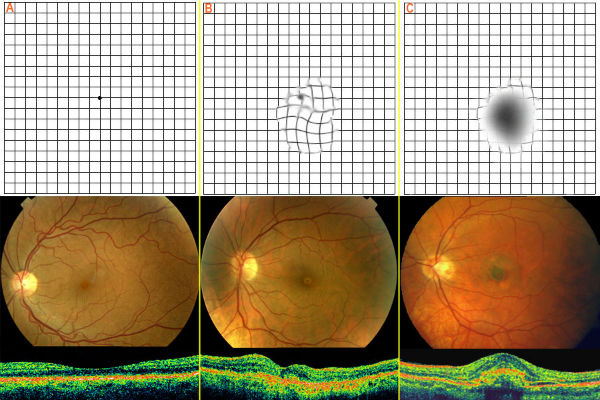
This is a condition involving a series of visual symptoms that can be detected. Straight lines may appear curved, distance perception may be impaired, and there may be increased sensitivity to light.
In the early stages, there may be blurred vision in the central part of the visual field, and in more advanced stages this may be accompanied by a dark spot, which can grow in size the longer the condition has been present.
The condition usually starts in one eye, although it eventually affects both. This is why the patient is unaware of the visual problem until macular degeneration has reached an advanced stage.